THE CONFIDENT VOICE
Conversations That Count
Mediation Services
When conversations break down, outcomes suffer.
Most disputes don’t start with major issues. They build over time, misunderstandings, assumptions, things left unsaid. By the time it reaches a breaking point, communication often feels difficult, tense, or avoided altogether. That’s where mediation comes in.
Mediation provides a structured, impartial space to work through difficult situations and reach a resolution that works for everyone involved. It’s not about deciding who is right or wrong. It’s about moving forward in a way that is practical, fair, and sustainable.
Mediation can help you:
Resolve ongoing disputes
Address breakdowns in working relationships
Navigate sensitive or high-pressure situations
Reach agreements without formal legal action
Have conversations that feel difficult to start alone
Who Can It Help?
Mediation can be useful in a wide range of situations, including:
· Individuals or businesses involved in a dispute who want to avoid formal legal proceedings
· Teams or colleagues experiencing tension, conflict, or breakdowns in working relationships
· Managers and leaders needing to address ongoing issues within their teams
· Individuals navigating difficult personal or professional relationships where communication has become strained
· Situations where conversations feel difficult to start, or have not led to resolution
Mediation is particularly helpful where there is a desire to find a way forward, even if agreement feels difficult at the outset. It is a voluntary and confidential process where an independent third party supports those involved in a dispute to have a structured conversation and work towards a resolution.
It is..
Impartial and non-judgemental
Focused on finding a way forward
Led by the people involved, not imposed by the mediator
Confidential (with some legal exceptions)
It is not..
Legal advice
Counselling or therapy
A process where someone is told they are right or wrong
A decision made by the mediator on behalf of the parties
The role of the mediator is to guide the conversation, manage the process, and create the conditions for a productive and constructive discussion.
Benefits
Mediation offers a practical and constructive alternative to escalation. Some of the key benefits include:
A quicker and more cost-effective route to resolution than formal legal processes
The opportunity to be heard and understood in a structured environment
Greater control over the outcome, rather than decisions being imposed externally
The ability to preserve or rebuild working and/or personal relationships
Confidentiality, helping to protect reputations and sensitive information
Outcomes that are realistic, workable, and agreed by all parties involved

Types of Mediation
Civil & Commercial
Disputes between individuals, businesses, or organisations where resolution is needed without escalation.
workplace
Supporting colleagues, managers, and teams to address conflict, rebuild working relationships, and move forward constructively.
Relationship
For situations where communication has become strained or difficult whether personal or professional and a structured conversation is needed to find a way forward.
How I Work
I offer mediation across a range of settings mentioned above. I provide a calm, structured and impartial environment where all parties can speak openly and be heard.
My approach is neutral and non-judgemental with a focus on practical outcomes that are grounded in real world experience of handling complex situations.
I understand how quickly conversations can become difficult when there is pressure, history, or uncertainty involved. My role is to guide the process so that those conversations can happen in a way that leads somewhere useful.
About Me
I am a CMC Registered Civil & Commercial Mediator, trained with Align Mediation.
Alongside my mediation training, I bring over 20 years of experience working in high pressure commercial environments, where clear communication and effective resolution are critical. Throughout my career, I’ve worked closely with individuals, teams and senior leaders navigating complex situations where relationships matter, expectations are high, and the impact of unresolved issues is felt quickly on performance, trust, and day-to-day working.
Much of that work has involved supporting people through difficult conversations whether addressing tension within teams, managing competing priorities, or finding a way forward when communication has broken down.
That experience shapes how I approach mediation.
I understand that most disputes aren’t just about the surface issue. They sit within relationships professional or personal and where assumptions, pressure, and past interactions all play a part. I also understand how quickly situations can escalate when things are left unsaid, avoided, or handled indirectly and how much can shift when those conversations are approached in a more structured, supported way.
This means I’m not only focused on the structure of mediation, but on what sits underneath it, the dynamics, the pressure, and the challenge of saying what needs to be said when it matters most. My role is to create the conditions for those conversations to happen properly so that people can be heard, understand each other more clearly, and move forward with an outcome that feels workable for everyone involved.
About Me
I am a CMC Registered Civil & Commercial Mediator, trained with Align Mediation.
Alongside my mediation training, I bring over 20 years of experience working in high pressure commercial environments, where clear communication and effective resolution are critical. Throughout my career, I’ve worked closely with individuals, teams and senior leaders navigating complex situations where relationships matter, expectations are high, and the impact of unresolved issues is felt quickly on performance, trust, and day-to-day working.
Much of that work has involved supporting people through difficult conversations whether addressing tension within teams, managing competing priorities, or finding a way forward when communication has broken down.
That experience shapes how I approach mediation.
I understand that most disputes aren’t just about the surface issue. They sit within relationships professional or personal and where assumptions, pressure, and past interactions all play a part. I also understand how quickly situations can escalate when things are left unsaid, avoided, or handled indirectly and how much can shift when those conversations are approached in a more structured, supported way.
This means I’m not only focused on the structure of mediation, but on what sits underneath it, the dynamics, the pressure, and the challenge of saying what needs to be said when it matters most. My role is to create the conditions for those conversations to happen properly so that people can be heard, understand each other more clearly, and move forward with an outcome that feels workable for everyone involved.
The Process
Mediation is flexible depending on the situation, but typically includes:
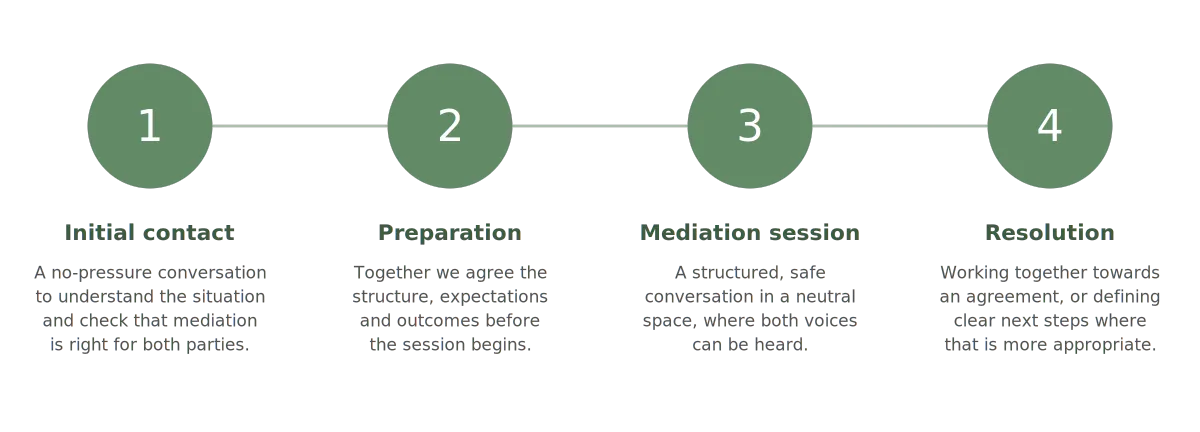
Sessions can be held in person or online.
The Process
Mediation is flexible depending on the situation, but typically includes:
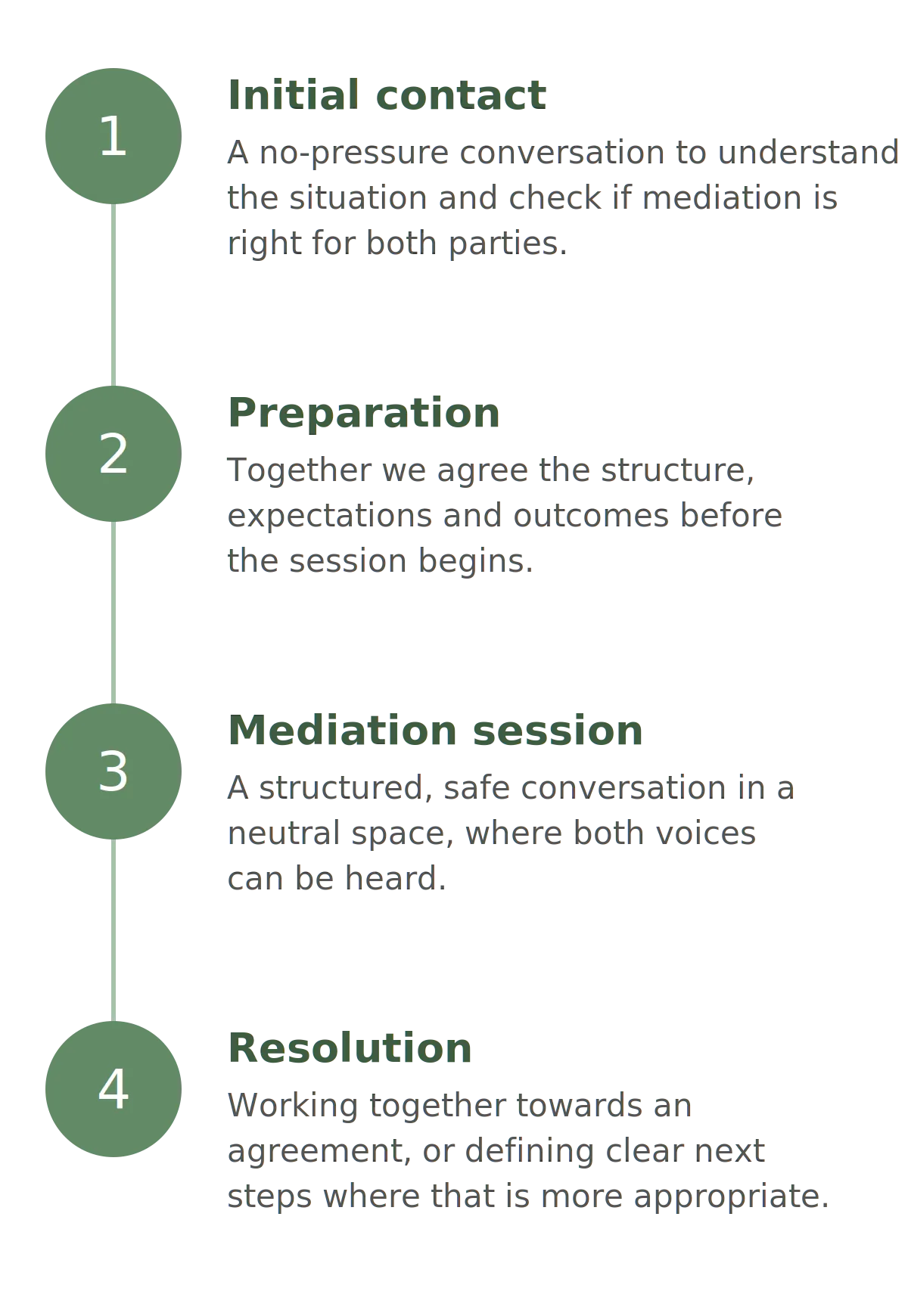
Sessions can be held in person or online.
Fees
Fees vary depending on the type, complexity and scale of the mediation.
In the UK, mediation fees are not fixed. They are influenced by factors such as the value of the dispute, the number of parties involved, and the level of preparation required.
Industry guidance and schemes such as those set by the Civil Mediation Council demonstrate that costs can range from lower fixed fees for small claims through to full-day rates for more complex disputes.
Civil & Commercial Mediation
£750 – £1,250 per party (full day)
This reflects standard UK market rates for independent civil and commercial mediators, where a typical full day mediation is charged at around £1,500 total and shared between parties. In civil and commercial mediation, fees are usually shared between the parties.
Please note fees may increase where:
- The dispute value is higher
- There are multiple parties
- Additional mediators, preparation or extended time is required
Workplace Mediation
£750 – £1,500 per day
£150 – £200 per hour (if applicable)
Workplace mediation is usually funded by the organisation and often includes:
- Pre-mediation meetings
- The mediation session
- Follow-up support where appropriate
Relationship Mediation
£130 – £170 per person per hour
This reflects guidance from the Family Mediation Council, where average mediation costs sit within this range. Fees are typically charged per person and may involve a series of shorter sessions.
Fees will vary depending on:
- The number of people involved
- The value and complexity of the dispute
- The level of preparation required
- Whether pre-mediation meetings are needed
- The length and format of the session (half day / full day / multiple sessions)
Mediation is designed to provide a cost-effective alternative to escalation.
By comparison, legal proceedings can run into thousands or significantly more depending on the nature of the dispute. Mediation offers a more controlled, timely, and proportionate way to resolve issues before they reach that stage.
Get in Touch
If you’re dealing with a situation that feels difficult to resolve, mediation can provide a way forward. You don’t need to have all the answers before starting just a willingness to address what’s there.
Copyright© 2025 Cheri McMahon
View Website Policies